What is Natural Burial?
Return to a simpler, more natural tradition.
Benefits of natural burial
Natural burial pays special attention to returning the body back to the earth in a safe way that is simple and natural, allows for greater family interaction, and is a more reasonable cost compared to conventional burial.

Environmentally-Friendly

Simple

Affordable

Choice
What exactly does natural burial look like?
Standard Burial
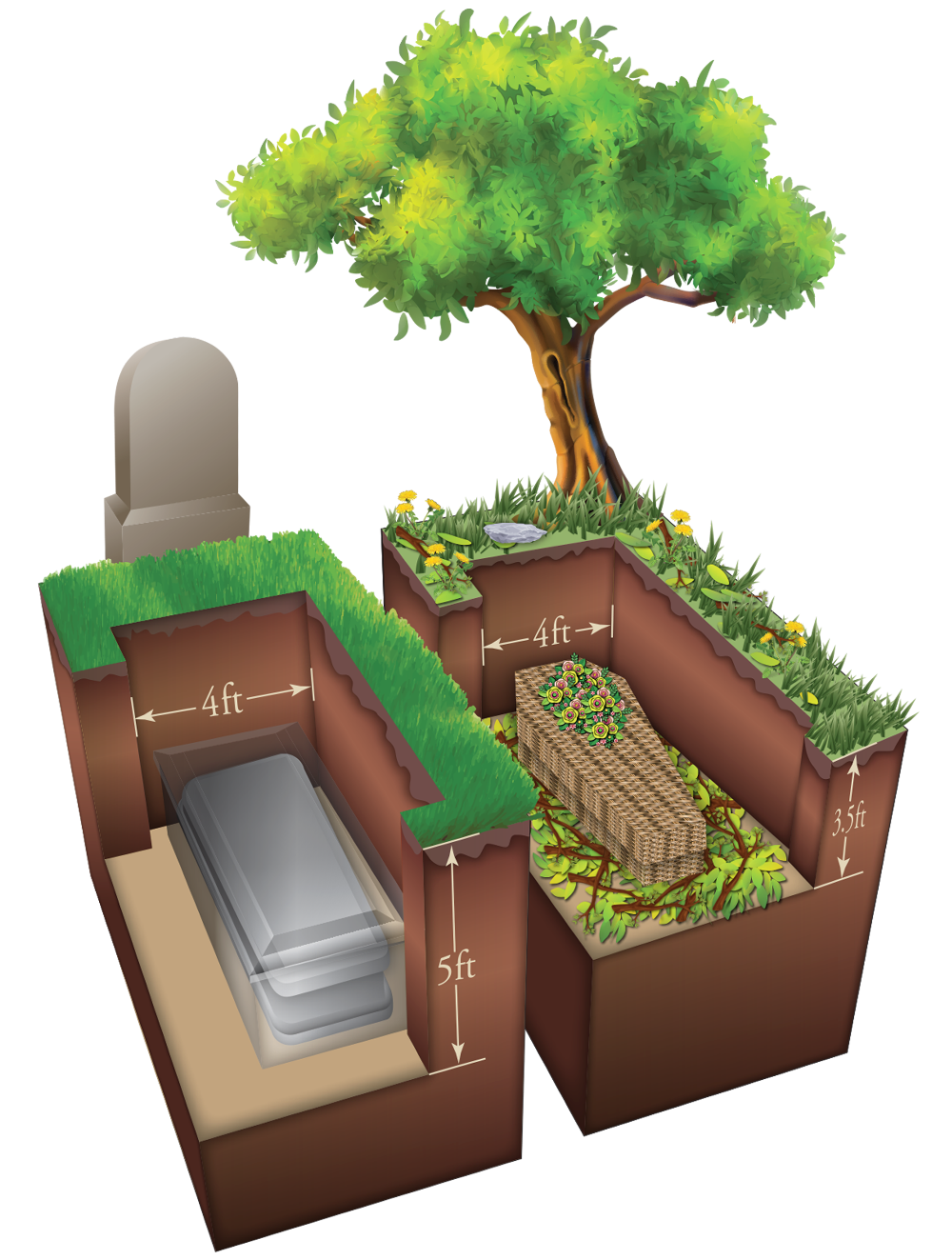
Standard burials typically use formaldehyde embalming, long-lasting caskets, and pricey headstones.

Natural Burial
The natural, or green, burial allows for only a biodegradable casket, shroud or urn which can help avoid the use of toxic chemicals, metal, and protects wildlife habitats and native plant communities. The depth of the grave is 3.5-4 feet, to stay inside the oxygenated portion of the ground, which aids in natural decomposition. Typically, there is no embalming, although the Green Burial Council allows specifically identified plant based fluids to be used.
The Green Burial Council certification standards only apply to full-body burial of human remains at a cemetery. They do not set standards for “reduction options” like flame cremation, aquamation, and human composting. These reduction processes are engineered to mimic or speed up the processes that occur naturally after death with non-renewable resources and some negative environmental impacts. See the Chart Below.
Final Disposition
(What happens to a body after death)
Comparison of Potential Environmental Benefits and Costs
Copyright Dr. Billy Campbell and Lee Webster, 2024
| Method | Net Carbon Footprint | Full Expenditure | Amount of Leftover Product for Disposal | Land Acreage Protected | Enviro Costs or Benefits |
|---|---|---|---|---|---|
| Natural Burial (Conservation Burial) | Sequesters 25 lbs CO2 per burial, 10 tons per acre | Transportation to the cemetery | 0 | Unlimited Strategic component of a complete land conservation plan |
Land protection Nutrient contributions to soil communities |
| Human Composting | Indeterminate greenhouse emissions | Sowing, watering, harvesting, processing, transporting of alfalfa, wood chips, bulking agents to facility; storage Construction, heating, cooling, maintenance of facility and its operating units Transporting of finished material |
1+ cubic yard of leftover material 10-15 lbs pulverized bone (calcium phosphate and sodium, 11.8 pH, 200 – 2000 x what plants can tolerate) | 0 | Materials acquisition Facility maintenance Trucking of leftover materials Smothered plant and soil communities in surface disposal Restoration of depleted soil if intentionally tilled or incorporated |
| Alkaline Hydrolysis | 150 to 200 lbs CO2 per person Most AH waste will be turned into carbon and nitrogenous GHG by public wastewater treatment facilities |
Electricity or propane to heat 100 gallons of water under pressure 3-12 hours Processing and transportation of potassium hydroxide (lye) |
100-300 gallons of effluent 10-15 lbs pulverized bone (calcium phosphate and sodium, 11.8 pH, 200-2000x what plants can tolerate) |
0 | Potential algae bloom from phosphorus run-off due to scattering Tree ringing (girdling) from burial close to tree roots Disposal of effluent (no state EPA has permitting) |
| Flame Cremation | 250 to 536 lbs CO2 emissions per person Mercury, particulate emissions into air and waterways |
Up to 500 gallons of fuel, usually natural gas, to burn @ 1700 to 2000° for 3-4 hours | 7-10 lbs pulverized bone (calcium phosphate and sodium, 11.8 pH, 200 – 2000 x what plants can tolerate) | 0 | Potential algae bloom from phosphorus run-off Tree ringing from burial close to tree roots Mercury poisoning of air and water |
For research-based information on environmentally responsible disposition options, see:
Cremation Curious https://vimeo.com/767868604
The Natural Burial Experience https://vimeo.com/769978957

Think natural burial may be the right fit?
Get in touch
Phone
240-NATURAL
(240-628-8725)
Text
Cemetery Location
2406 Ridge Road
Windsor Mill, MD 21244
Gates open everyday from 7am-5pm
Appointment hours 9am-3pm
For any questions you may have, please feel free to contact us and someone will get back to you.
Subscribe to our Newsletter
Sign up to receive updates about Serenity Ridge in your inbox.
Subscribe to our Newsletter
Sign up to receive updates about
Serenity Ridge in your inbox.