
On the night of March 4, 2026, an estimated 8,100 birds crossed Baltimore County while most people slept. By late April, that number climbs into the millions on a single active night, according to the BirdCast Migration Dashboard for Baltimore County. These birds urgently need safe places to land, feed, and rest before continuing their journey north. Where they touch down can determine their survival. This makes planning a guided spring habitat hike more than just a leisure activity—it’s an opportunity to witness a critical moment in migration.
When you join a professional spring habitat hike on conserved land, you’re not simply taking a walk in the woods. You’re arriving in the right habitat the morning after a major migratory flight, when trees and meadows are suddenly alive with species that were hundreds of miles south just hours before. The forests, meadows, and valleys at Serenity Ridge Natural Burial Cemetery, adjacent to Patapsco State Park in Windsor Mill, Maryland, lie within one of the most active stopover corridors in the mid-Atlantic region.
What Does a Professional Habitat Hike Actually Show You?
The Difference Between Walking and Watching
Most people who enjoy the outdoors move through natural spaces without truly noticing the stories those habitats tell. A trained naturalist guide changes that. On a professional hike, your perspective shifts—starting with slowing down. Guided hikes at conserved properties like those run by Nature Forward at the Woodend Nature Sanctuary explore habitat layers rather than simply following a linear trail. The canopy, understory, shrub layer, and ground cover each host different species at various times of morning, and a guide helps you interpret these layers based on factors like time, temperature, and wind.
Listening comes before looking. Many spring migrants, particularly warblers and vireos, announce themselves with song before becoming visible. A trained guide teaches participants to:
- Separate individual songs from background noise
- Locate the singer by sound before searching visually.
- Confirm identification through field marks once the bird is found.
Behavioral cues are just as important as visual identification. For example, a Yellow-rumped Warbler forages low, while a Black-throated Green Warbler prefers the upper canopy. Understanding where each species feeds changes how—and where—you search, and a guided hike helps you build that spatial awareness as you go.
Why Stopover Habitat Matters More Than the Migration Route
Migration routes are broad corridors. What actually determines whether a bird survives long-distance flight is the quality of its stopover sites. A bird crossing hundreds of miles overnight burns through stored fat. When it lands at dawn, it needs dense insect populations, fresh water, and cover. Fragmented or invasive-dominated habitat forces the bird to move on, often fatally.
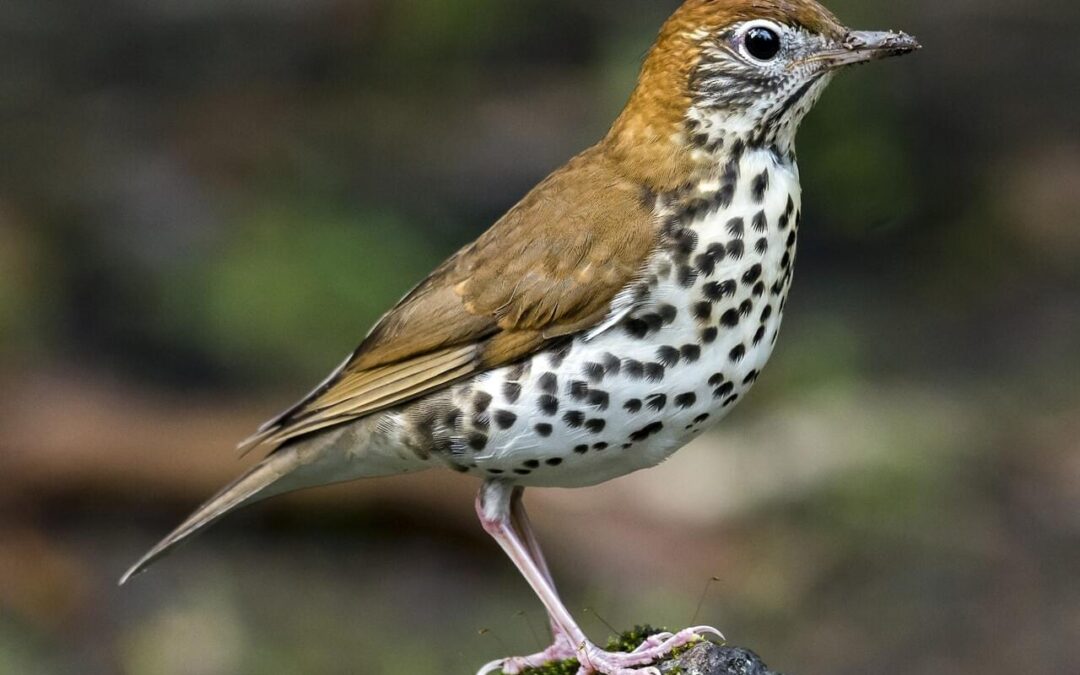
The Maryland DNR Wild-Acres Program identifies focal migratory species whose populations are most sensitive to stopover habitat quality in the Piedmont region. The Wood Thrush and Cerulean Warbler both appear on that list. Both depend on:
- Mature forest interior with healthy understory growth
- High insect abundance tied to native plant communities
- Low edge-to-interior ratios that reduce nest predation pressure
Serenity Ridge is both a Level I Certified Arboretum and a nature preserve bordered on multiple sides by Patapsco State Park. Its mix of meadows, woodland edges, and mature forest canopy across 177 acres forms a true habitat mosaic. Mosaic habitats support greater species diversity, as different birds rely on different structural layers. For visitors on a spring morning hike, this means every outing offers a varied and often surprising experience.
Which Species Are Moving Through the Baltimore Region in Spring?
Warblers, Vireos, and the Piedmont Corridor
Maryland’s Piedmont region lies within the Atlantic Flyway, one of North America’s four primary bird migration corridors. Each spring, this corridor channels dozens of warbler species north from wintering grounds in Central America, the Caribbean, and South America. Audubon’s Bird Migration Explorer reveals the full journeys of 458 species, illustrating how mid-Atlantic habitats like Serenity Ridge connect wintering and breeding ranges across the hemisphere.
Among the most reliably observed species in Baltimore County during April and May:
- Yellow Warbler: arrives mid-April, favors shrubby meadow edges and wetland margins.
- Common Yellowthroat: found throughout brushy areas and meadow borders
- Ovenbird: a ground-nesting warbler of mature forest, sings loudly from leaf litter
- Red-eyed Vireo: one of the most abundant forest migrants in the region
- Wood Thrush: a focal Piedmont conservation species, identifiable by its flute-like forest song
- Baltimore Oriole: arrives reliably in early May and is often heard before seen in the canopy.
Light pollution disrupts stopover decisions more than most visitors realize. Nocturnal migrants orient themselves using starlight and magnetic fields, but artificial lighting can pull them off course and concentrate them around illuminated structures—greatly increasing collision risks. Audubon Maryland-DC reports that turning off lights from midnight to 6 AM between April 1 and May 31 can reduce bird collision deaths by up to 80 percent. Conserved properties with minimal artificial lighting provide safer stopover environments precisely because they preserve natural darkness.
What the Meadow and the Woodland Reveal at Different Times of Day
The two primary habitat zones at Serenity Ridge each support distinct communities of spring migrants, and the optimal observation window shifts between them as the morning progresses.
From first light through roughly 8:30 AM, the Valleys and Meadows sections are most productive. Open-country and edge species move through meadow grasses and native wildflower beds during this window. Watch for:
- Eastern Meadowlarks and Bobolinks are passing through open ground.
- Tree and Barn Swallows are feeding low over the meadow.
- Eastern Kingbirds and other flycatchers working the field edges
After 8:30 AM, attention shifts to the wooded areas near Inspiration Point. Forest-interior birds are most active during the cool, mid-morning hours when insects begin to stir in the canopy. This is the best time to spot warblers high above, thrushes on the forest floor, and Scarlet Tanagers moving through the mid-canopy. A well-designed hike follows the birds’ movements, sequencing these zones intentionally rather than sticking to a rigid path.
When Should You Plan a Spring Habitat Hike in Maryland?
The Mid-April to Mid-May Window
The BirdCast Migration Dashboard for Baltimore County shows migration intensity rising sharply in mid-April and sustaining through mid-May before tapering. During this period, millions of birds move through the county on active nights. The morning after a high-intensity migration night is the single most productive time to be in the field.
BirdCast updates nightly, making it possible to check conditions the evening before a planned hike. A few practical planning notes:
- High-intensity BirdCast readings signal productive mornings the following day.
- Nights with southerly winds carry migrants north efficiently.
- Cold fronts from the north temporarily ground birds and concentrate them in stopover habitats.
- Mornings after overnight temperatures above 50°F and calm southwesterly winds are consistently the most rewarding for observation.
Why the First Two Weeks of May Are Worth Marking on Your Calendar
The Maryland Ornithological Society’s annual May Count, conducted during the first two weeks of May, documents the highest species diversity recorded anywhere in Maryland’s birding calendar. This window captures the peak overlap between late-arriving tropical species and year-round residents already nesting. A single quality morning during this stretch, in good stopover habitat, regularly produces 40 or more species.
The timing also aligns with native plant bloom cycles at Serenity Ridge. Serviceberry, wild cherry, and native oaks begin producing catkins and blooms in late April, triggering a surge in caterpillar and invertebrate activity. Migrating warblers and vireos time their arrival to match this insect emergence. The biological timing is not coincidental. Decades of ecological research confirm that migratory songbirds synchronize their arrival with peak invertebrate abundance at stopover sites, which is exactly why quality native plant communities matter so much to what you observe on any given morning.
How Does a Conserved Landscape Support What You Will See?
Native Plants, Insects, and the Chain That Feeds Migration
The link between native plants and migratory birds runs directly through insects. Maryland DNR Wild-Acres Program research shows that native plants support vastly more caterpillar and invertebrate species than introduced ornamentals—a native oak may host over 500 Lepidoptera larvae species, while non-native ornamentals might support fewer than five. Migratory songbirds depend on this abundance during stopovers. Just one warbler may eat hundreds of insects daily to restore its energy after a long flight.
At Serenity Ridge, the Nature Preserve team, which now operates as its own nonprofit, focuses on:
- Removing invasive plant species that crowd out the native understory
- Reintroducing Maryland-native trees and shrubs throughout the property
- Developing pollinator and wildlife gardens that extend habitat function across the grounds
The Level I Arboretum designation reflects a documented collection of native and regionally appropriate trees managed for ecological and educational value. For a visitor on a spring morning hike, the practical effect is visible in every layer of the habitat.
What 177 Protected Acres Means for a Birding Morning
Development pressure is one of the primary forces degrading stopover habitat quality across the mid-Atlantic. When forest patches fragment, interior-dependent species like the Wood Thrush lose access to the habitat depth they require. A property protected in perpetuity and bordered by an existing state park removes that pressure entirely.
The Patapsco Heritage Greenway partnership that Serenity Ridge maintains extends the effective habitat corridor well beyond the property’s boundaries. Birds moving north through the Piedmont do not stop at property lines. A bird landing in Patapsco State Park at dawn and moving into the Serenity Ridge meadows as the morning warms is navigating a continuous habitat system. For a visitor on a guided hike, that connectivity produces higher species counts and more sustained observation opportunities than a smaller, isolated parcel would offer.
The grounds stay open during daylight hours, and no permanent artificial lighting interrupts the natural dark that migrants depend on for safe orientation.
How to Join a Spring Habitat Hike at Serenity Ridge
What the Hike Includes
Guided spring habitat hikes at Serenity Ridge are led by naturalists familiar with the property’s specific habitat zones and the species most likely to be present during each migration phase. A few things to know before you arrive:
- Hikes run approximately two hours, beginning at or before sunrise.
- Groups are kept small to minimize disturbance and maximize observation quality.
- No prior birding experience is required.
- Participants are encouraged to bring binoculars, wear layers, and move quietly.
The hike covers both the Valleys and Meadows sections and the wooded areas near Inspiration Point, following the morning sequence from open meadow to forest interior as the birds move through their feeding cycle.
Schedule a Tour or Register for a Spring Hike Event
Walking the Serenity Ridge grounds is the most common first step for families considering natural burial, and for many visitors, a spring hike is what brings them to the property for the first time. The combination of the Nature Preserve’s programming and the cemetery’s open-grounds policy keeps the land accessible and active throughout the spring season.
To register for an upcoming event, visit us at the Events page or call 240-466-9296. The staff responds directly. Bringing your binoculars and arriving before the birds do is all the preparation you need.